
What Is Worth Instrumenting First in a Resource-Constrained System
When time and budget are limited, instrumentation should begin with the places where user harm and operational uncertainty intersect.

Instrumentation decisions are often treated as a technical detail, but in constrained environments they are really prioritization decisions about risk.
If a team cannot instrument everything at once, it needs a clear rule for where to begin. The best place is where user impact is high and the current ability to explain failure is low.
Where teams get stuck
A common mistake is instrumenting what is easiest rather than what is most consequential. That produces clean dashboards around low-risk services while the real operational pain remains opaque.
What works in practice
Start with money, trust, and access
Payment completion, account access, order creation, care delivery workflows, and partner message delivery are typical high-value starting points because failure there is immediately costly.
Prefer instrumentation that shortens diagnosis
A signal is valuable when it helps an engineer decide where to look next. Metrics without decision value should wait. A consistent OpenTelemetry service naming standard makes ownership clear, while a metric cardinality budget keeps the first useful signals bounded.
Review gaps after every release and incident
Instrumentation priorities change as systems evolve. Teams need a habit of revisiting what the last outage exposed.
What to do next
- Rank your top workflows by user impact and debugging difficulty.
- Instrument the first two workflows end to end before expanding broadly.
- Use on-call feedback to identify where visibility is still weakest.
Good instrumentation starts with operational honesty. Teams should instrument what hurts, not just what is convenient.
Need help improving observability in constrained environments?
Observability Africa works with telecom, fintech, energy, and platform teams to improve monitoring, alerting, incident response, and operational resilience.
Explore our services or contact us to discuss your current observability challenges.

About Abe Apithy
Abe Apithy is the founder of Observability Africa, a platform dedicated to helping telecom, fintech, and energy organizations design and scale resilient, high-performance digital infrastructure. His work focuses on enabling real-time system visibility, operational reliability, and performance optimization in environments where downtime, latency, and inefficiency…
Related guides

Trace the Message, Not Just the Request: Observability Across Queues
Asynchronous systems break the straight line between request and response. Learn how to preserve trace context, model message processing, and detect failures across queues.
OpenTelemetry Collector Memory Limits: Preventing Backpressure from Becoming Data Loss
A practical guide to configuring OpenTelemetry Collector memory limits, understanding backpressure, and preventing data loss during traffic bursts or backend outages.
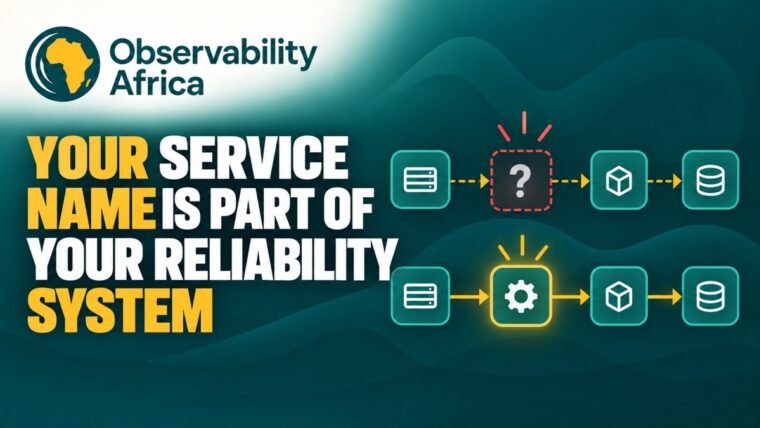
OpenTelemetry Service Naming: A Practical service.name Standard
Inconsistent OpenTelemetry service identity breaks service maps, dashboards, alert ownership, and incident response. Use a small identity contract to make telemetry dependable.