
Finding Blind Spots in Distributed Systems with Minimal Telemetry
Even without exhaustive tracing, teams can reveal the most dangerous blind spots in multi-service systems through disciplined instrumentation.
Distributed systems create new failure modes, but not every team can afford or operate full-detail tracing everywhere. That does not mean they have to accept blindness.
Many modern services span APIs, queues, background workers, external providers, and data stores. In constrained environments, the question becomes how to regain visibility without turning observability into its own scaling problem.
Where teams get stuck
Blind spots emerge where ownership changes, where retries mask errors, or where work moves asynchronously between services. Without intentional instrumentation, teams see symptoms but cannot explain where the breakdown happened.
What works in practice
Track transactions across service boundaries
Correlation IDs carried through logs and event metadata can often provide enough continuity to understand how work moved through the system.
Instrument state transitions, not only endpoints
The most useful signals often live around enqueue, dequeue, retry, timeout, and handoff events rather than only request start and finish. A resilient OpenTelemetry Collector pipeline helps preserve that evidence when a downstream system or network path is unavailable.
Sample deeply where failure is hardest to explain
If full tracing is too expensive, reserve detailed tracing or enriched logs for high-risk flows and incident windows.
What to do next
- Map the top asynchronous workflows in your architecture and identify where visibility disappears.
- Standardize correlation IDs across services, queues, and scheduled jobs.
- Add instrumentation at state transitions that currently rely on guesswork during incident review.
Minimal telemetry does not have to mean weak telemetry. With good instrumentation choices, teams can illuminate the system edges that matter most.
Need help improving observability in constrained environments?
Observability Africa works with telecom, fintech, energy, and platform teams to improve monitoring, alerting, incident response, and operational resilience.
Explore our services or contact us to discuss your current observability challenges.

About Abe Apithy
Abe Apithy is the founder of Observability Africa, a platform dedicated to helping telecom, fintech, and energy organizations design and scale resilient, high-performance digital infrastructure. His work focuses on enabling real-time system visibility, operational reliability, and performance optimization in environments where downtime, latency, and inefficiency…
Related guides

Trace the Message, Not Just the Request: Observability Across Queues
Asynchronous systems break the straight line between request and response. Learn how to preserve trace context, model message processing, and detect failures across queues.

OpenTelemetry Collector Memory Limits: Preventing Backpressure from Becoming Data Loss
A practical guide to configuring OpenTelemetry Collector memory limits, understanding backpressure, and preventing data loss during traffic bursts or backend outages.
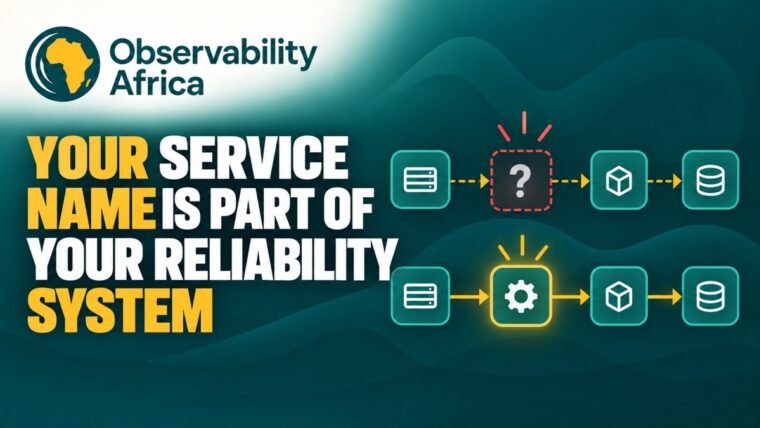
OpenTelemetry Service Naming: A Practical service.name Standard
Inconsistent OpenTelemetry service identity breaks service maps, dashboards, alert ownership, and incident response. Use a small identity contract to make telemetry dependable.