
Why Incident Retrospectives Matter in Resource-Constrained Environments
Retrospectives help teams turn painful incidents into repeatable operational learning, especially when every outage carries outsized cost.

When infrastructure, staffing, and tooling are all constrained, every avoidable repeat incident becomes more expensive. Retrospectives are one of the highest-leverage habits a team can build.
Across many African organizations, the same engineers who ship features are also the ones diagnosing outages, speaking to stakeholders, and implementing fixes. That makes learning loops especially important because operational memory cannot stay trapped in individual heads.
Where teams get stuck
Teams often close an incident once the service is back, but without documenting the timeline, the missing signals, and the decisions that slowed diagnosis, the next outage begins with the same blind spots.
What works in practice
Capture what was hard to see
A strong retrospective identifies which dashboards were misleading, which logs were missing, and which dependencies were poorly instrumented. That is where observability improvement becomes concrete.
Focus on system behavior, not blame
The goal is to understand why the team and the tooling made reasonable but insufficient decisions under pressure. Blame reduces reporting quality and weakens future learning.
Translate lessons into backlog items
Every retrospective should leave behind specific follow-up work such as new alerts, revised runbooks, simpler dashboards, or safer release controls.
What to do next
- Create a standard retrospective template with timeline, impact, detection, diagnosis, and follow-up sections.
- Track which observability gaps are showing up repeatedly across incidents.
- Review whether previous retrospective actions were actually completed.
In constrained environments, retrospective discipline is a force multiplier. It turns every outage into a chance to reduce future uncertainty.
Need help improving observability in constrained environments?
Observability Africa works with telecom, fintech, energy, and platform teams to improve monitoring, alerting, incident response, and operational resilience.
Explore our services or contact us to discuss your current observability challenges.

About Abe Apithy
Abe Apithy is the founder of Observability Africa, a platform dedicated to helping telecom, fintech, and energy organizations design and scale resilient, high-performance digital infrastructure. His work focuses on enabling real-time system visibility, operational reliability, and performance optimization in environments where downtime, latency, and inefficiency…
Related guides

A Green Health Check Does Not Mean Users Are Fine
A healthy process can still deliver a broken user journey. Learn how to combine probes, service telemetry, and end-to-end checks.
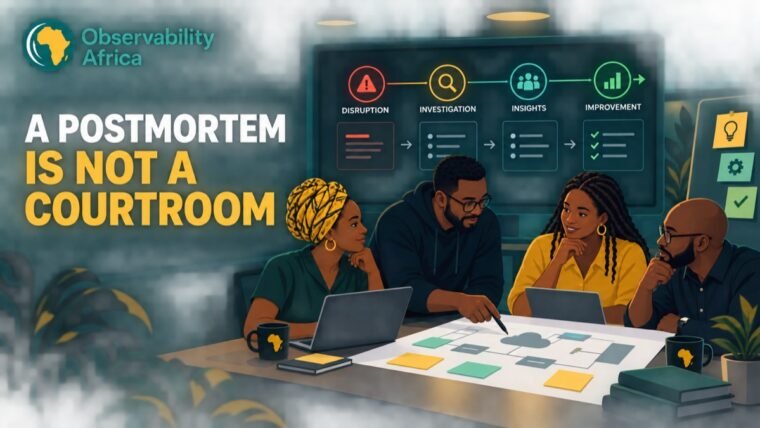
A Postmortem Is Not a Courtroom: How Lean Teams Learn Without Blame
A useful incident review explains how failure became possible. Learn how lean teams can build factual timelines, find contributing conditions, and turn lessons into verified improvements.
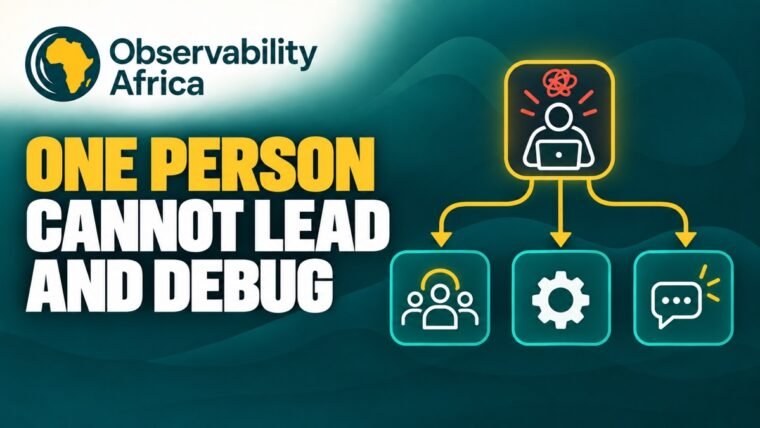
One Person Cannot Lead and Debug: A Lean Incident Command Model
Lean engineering teams need clear incident roles too. Separate command, technical response, and communication to protect focus and improve recovery.