
What Telecom Operators Can Learn from Modern Observability Practices
Why telecom environments expose reliability gaps quickly and what other digital teams can learn from their observability discipline.
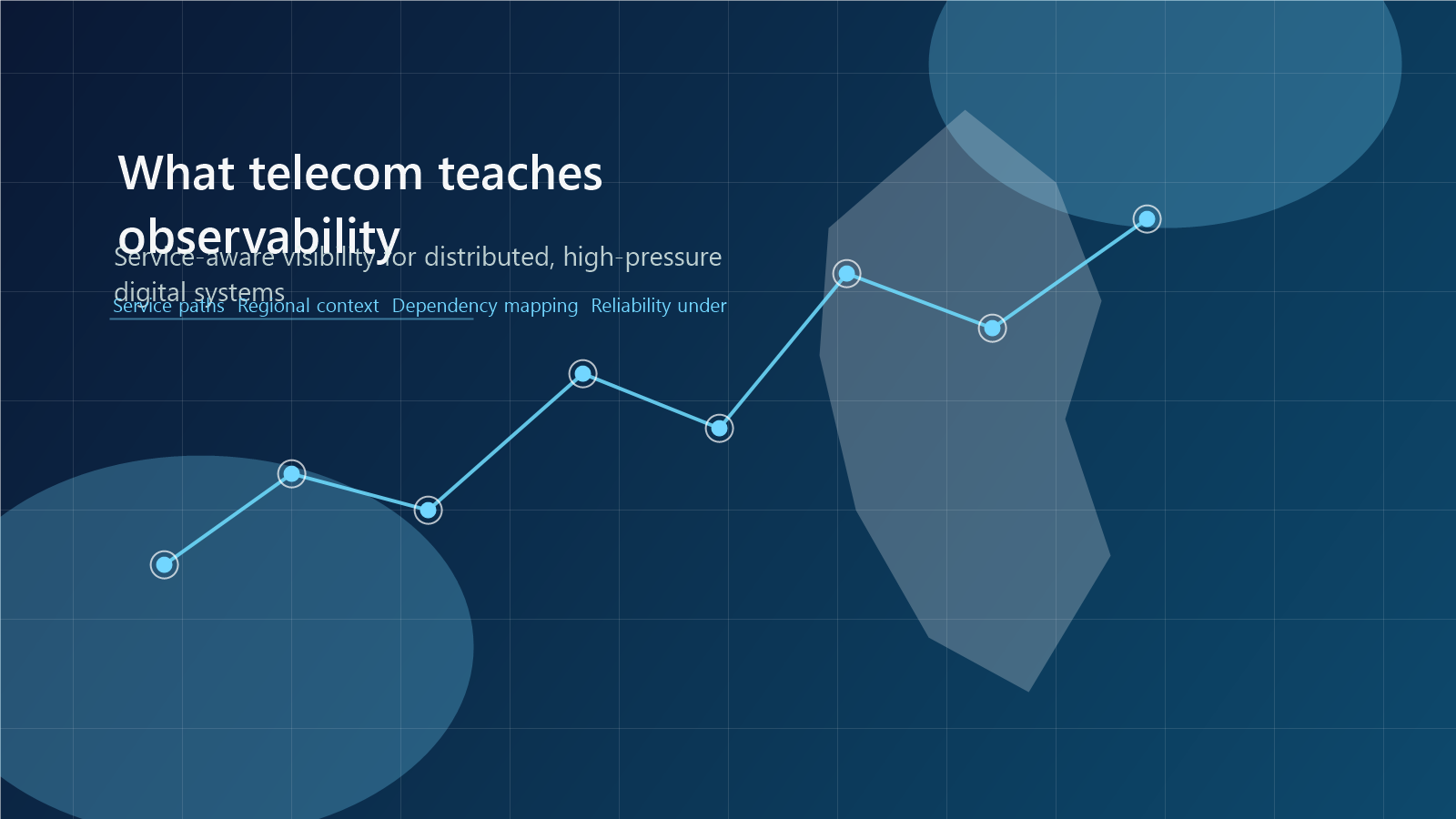
Telecom environments expose operational truth very quickly. When a digital product fails in a lower-volume setting, the impact may build gradually. In telecom, service degradation is often immediate, widespread, and visible to customers, partners, and internal operations teams at the same time. That makes telecom one of the most demanding environments for observability, and one of the most instructive.
Even teams outside telecom can learn from the way these systems are forced to think about scale, service dependency, regional variability, and reliability under constant pressure. Modern observability practices are not valuable here because they are fashionable. They are valuable because they help teams understand what is happening before performance issues become trust issues.
Why telecom is such a useful observability teacher
Telecom systems operate across distributed infrastructure, layered services, and customer experiences that are often extremely sensitive to degradation. Problems rarely stay isolated for long. A dependency issue in one part of the stack can show up as failed calls, delayed messages, unreachable APIs, poor portal performance, or sudden operational noise in multiple places at once.
That makes simplistic monitoring insufficient. Looking at isolated server metrics or waiting for hard failures does not provide enough operational clarity. Teams need a way to connect infrastructure signals, application behavior, service dependencies, and customer impact quickly.
This is exactly where observability becomes more than a collection of dashboards. It becomes a way of seeing the system as a connected operating environment.
Lesson 1: Monitor services, not just components
One of the biggest telecom lessons is that healthy components do not guarantee healthy services. A cluster can look stable while customers are still unable to complete an action. A network-facing service can stay technically available while latency or dependency failures quietly degrade the user experience.
Modern observability practices push teams toward service-level visibility. That means tracking customer journeys, request success paths, transaction completion, and degradation patterns that actually reflect how the service is consumed. For telecom operators, this might mean visibility into provisioning flows, subscriber operations, billing transactions, integration latency, or service availability by region.
For other sectors, the lesson is the same: build signal coverage around the service outcome, not only around the underlying machine state.
Lesson 2: Regional context matters
Telecom operators often work across geographies where infrastructure conditions, user density, device behavior, and service usage patterns differ sharply. A signal that looks normal in one region may be a warning sign in another. A baseline that works nationally may hide a local problem with real customer consequences.
That is why observability models need context. Regional dashboards, locality-aware baselines, and segmented alerting matter because they reduce the blindness created by aggregation. The same principle applies in cloud platforms, fintech, and distributed public services. If traffic, connectivity, or dependency behavior differs by market or region, observability should reflect that directly.
Lesson 3: Dependency visibility is non-negotiable
Telecom environments rarely fail because of one obvious component alone. They fail through interaction: between APIs, identity systems, data stores, message brokers, external links, network services, and internal tooling. Teams that cannot see those relationships clearly lose valuable time during diagnosis.
Modern observability helps by strengthening dependency awareness. Distributed tracing, service maps, and correlation between metrics, logs, and request paths help teams answer a more useful question than what is red right now. They help answer why the failure is spreading, where the real point of degradation began, and what downstream systems are already affected.
For organizations growing in complexity, this is one of the most transferable lessons from telecom. As dependency chains deepen, root cause analysis becomes harder unless visibility is designed intentionally.
Lesson 4: Reliability needs operational rhythm, not just tooling
Telecom pressure teaches another important lesson: tools alone do not create resilient operations. Teams also need disciplined operational habits. That includes alert review, threshold tuning, incident notes, ownership clarity, change visibility, and post-incident learning.
In high-pressure service environments, stale alerts and unclear ownership are expensive. If the monitoring system cannot be trusted, operators start ignoring it. If change events are not visible, diagnosis slows down. If incidents are resolved without learning, the same problems return with slightly different symptoms.
This is why modern observability should be treated as an operational practice, not just a tooling stack. Telecom reminds us that speed of response depends as much on operating model as on instrumentation.
Lesson 5: Capacity and cost signals should sit next to reliability signals
Another strong telecom lesson is that reliability and efficiency are connected. It is not enough to know whether a system is up. Teams also need to know whether load, queue behavior, retry patterns, saturation, or noisy dependencies are pushing the service into a fragile state.
That makes capacity visibility central. Modern observability should reveal where demand is rising, where telemetry cost is growing faster than value, and where the system is compensating in ways that are operationally expensive. For telecom operators, this is part of staying ahead of service degradation. For other organizations, it is part of keeping scale sustainable.
The broader lesson is simple: observability should help teams see not only present failure, but emerging fragility.
What other teams can apply right away
You do not need to operate a telecom network to apply these lessons. Most growing digital teams can start with a practical adaptation of the same thinking:
- Define the service journeys that matter most to customers and track them directly.
- Segment visibility by region, product surface, or dependency path where behavior differs.
- Map the dependencies most likely to create cascading impact and improve traceability there first.
- Review alert quality regularly so the signal set remains useful under pressure.
- Pair reliability metrics with load, saturation, and cost indicators to catch fragility early.
These are not telecom-only practices. They are mature operational habits that become increasingly important as systems scale and diversify.
Why this matters for African digital infrastructure
Across African digital markets, telecom infrastructure has often had to operate under real-world constraints that other sectors are only beginning to feel: uneven connectivity, regional variability, customer sensitivity to service disruption, and constant pressure to grow without losing reliability. That makes telecom a particularly valuable reference point for observability maturity on the continent.
For fintech, logistics, energy, cloud platforms, and public digital systems, the lesson is not to imitate telecom architecture blindly. It is to learn from telecom’s operational discipline. Systems that affect trust at scale need visibility that is service-aware, context-aware, and resilient under stress.
Key takeaway
Telecom operators do not get the luxury of treating observability as an optional layer. They need it because service degradation is visible quickly and customer trust erodes fast. That urgency creates useful lessons for everyone else.
The more your systems grow in scale, complexity, and customer importance, the more observability needs to move beyond dashboards and become a real operating capability.
Need help improving observability in high-pressure environments?
Observability Africa helps teams build clearer service visibility, stronger alerting, and better operational decision-making across distributed and resource-constrained systems.
Explore our services or contact us if you want to improve reliability before complexity turns into operational drag.

About Abe Apithy
Abe Apithy is the founder of Observability Africa, a platform dedicated to helping telecom, fintech, and energy organizations design and scale resilient, high-performance digital infrastructure. His work focuses on enabling real-time system visibility, operational reliability, and performance optimization in environments where downtime, latency, and inefficiency…
Related guides

A Green Health Check Does Not Mean Users Are Fine
A healthy process can still deliver a broken user journey. Learn how to combine probes, service telemetry, and end-to-end checks.
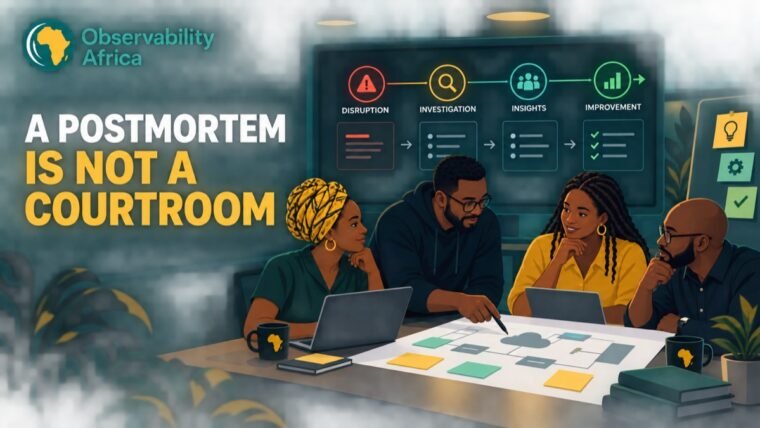
A Postmortem Is Not a Courtroom: How Lean Teams Learn Without Blame
A useful incident review explains how failure became possible. Learn how lean teams can build factual timelines, find contributing conditions, and turn lessons into verified improvements.
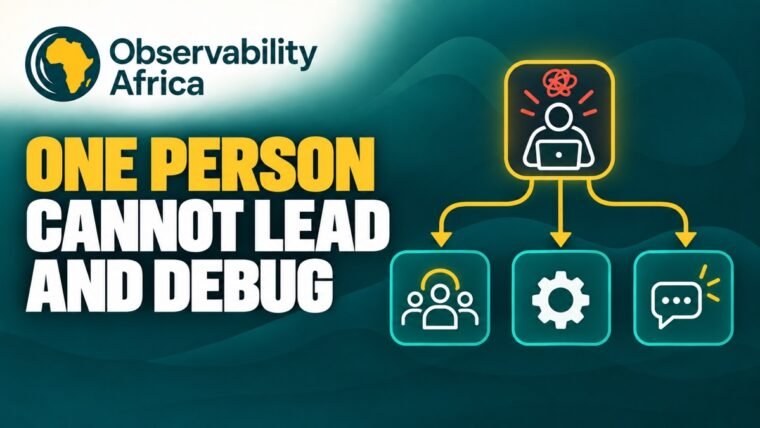
One Person Cannot Lead and Debug: A Lean Incident Command Model
Lean engineering teams need clear incident roles too. Separate command, technical response, and communication to protect focus and improve recovery.