
Navigating Outages Without Perfect Network Visibility
Incident response must still work when logs arrive late, metrics are partial, or the network path itself is part of the problem.

Some of the hardest incidents happen when the systems used to observe the outage are also degraded. That is a familiar challenge for teams operating across unstable or fragmented network conditions.
Whether the issue is a provider outage, regional link instability, or a saturated internal connection, engineers may need to respond with incomplete information. That requires observability strategies designed for uncertainty.
Where teams get stuck
Teams often assume they will have perfect visibility during the exact moments when they need it most. When that assumption fails, they lose time trying to confirm basic facts about scope, impact, and probable fault domains.
What works in practice
Use multiple independent signals
Synthetic checks, host metrics, application health indicators, and user-facing transaction probes together create a more resilient picture than any single source alone.
Build incident dashboards that tolerate data gaps
Operators should be able to see the most recent known state, missing telemetry windows, and fallback indicators without interpreting silence as health. A resilient OpenTelemetry Collector pipeline makes that failure boundary visible and provides a tested recovery path.
Keep runbooks grounded in degraded-mode reality
When network visibility is partial, the runbook should tell engineers which checks remain reliable and how to narrow scope without full telemetry.
What to do next
- Identify which operational signals remain available when your main dashboard is degraded.
- Add fallback probes for critical user journeys and regional reachability.
- Run outage drills where the monitoring system itself is partially impaired.
Perfect visibility is a luxury. Good incident response comes from planning for the moments when visibility is incomplete.
Need help improving observability in constrained environments?
Observability Africa works with telecom, fintech, energy, and platform teams to improve monitoring, alerting, incident response, and operational resilience.
Explore our services or contact us to discuss your current observability challenges.

About Abe Apithy
Abe Apithy is the founder of Observability Africa, a platform dedicated to helping telecom, fintech, and energy organizations design and scale resilient, high-performance digital infrastructure. His work focuses on enabling real-time system visibility, operational reliability, and performance optimization in environments where downtime, latency, and inefficiency…
Related guides
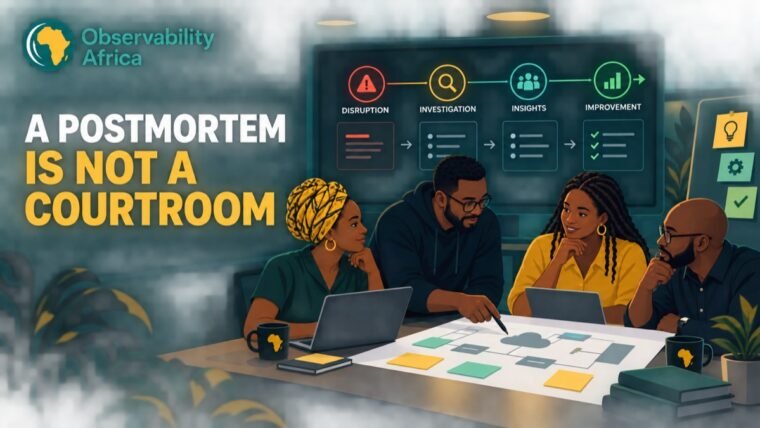
A Postmortem Is Not a Courtroom: How Lean Teams Learn Without Blame
A useful incident review explains how failure became possible. Learn how lean teams can build factual timelines, find contributing conditions, and turn lessons into verified improvements.
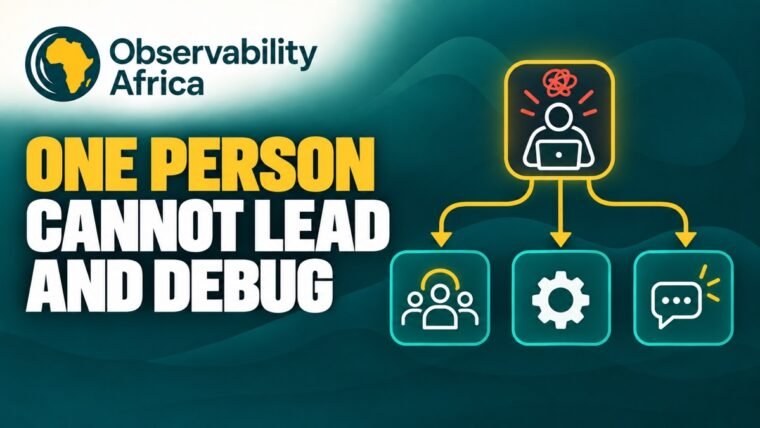
One Person Cannot Lead and Debug: A Lean Incident Command Model
Lean engineering teams need clear incident roles too. Separate command, technical response, and communication to protect focus and improve recovery.
Why Observability Engineering Matters in Africa’s Digital Transformation
Why observability engineering is foundational to trust, resilience, and scalable digital growth across Africa’s evolving digital systems.