
Why Resilience Matters More Than Tooling Fashion
Teams should evaluate observability tools by how they improve resilience under local conditions, not by whether they mirror the latest global stack trend.

Technology teams are constantly exposed to new tooling narratives. The danger is confusing popularity with suitability.
For many organizations operating in Africa or other constrained environments, the most pressing questions are not whether a stack is fashionable. They are whether it survives outages, fits team capacity, and helps restore service under stress.
Where teams get stuck
Tooling decisions often prioritize feature count over operational fit. That leads to fragmented telemetry, difficult maintenance, and expensive systems that do not materially improve recovery time.
What works in practice
Evaluate tools against failure scenarios
Ask how the platform behaves when a dependency is slow, an agent drops data, an office link fails, or an engineer on call is not a specialist in the stack.
Prefer systems the team can explain and operate
A simpler stack with clear ownership is often more resilient than an advanced stack that only one person understands.
Measure adoption in operational terms
If a new tool does not shorten diagnosis, improve alert quality, or make post-incident learning easier, it may be adding complexity without value.
What to do next
- List the operational outcomes you want before evaluating new observability tools.
- Retire tools that overlap heavily but do not improve response quality.
- Treat resilience as the main buying criterion, not the number of features in a demo.
The strongest observability programs are rarely the trendiest ones. They are the ones teams can trust when pressure is high.
Need help improving observability in constrained environments?
Observability Africa works with telecom, fintech, energy, and platform teams to improve monitoring, alerting, incident response, and operational resilience.
Explore our services or contact us to discuss your current observability challenges.

About Abe Apithy
Abe Apithy is the founder of Observability Africa, a platform dedicated to helping telecom, fintech, and energy organizations design and scale resilient, high-performance digital infrastructure. His work focuses on enabling real-time system visibility, operational reliability, and performance optimization in environments where downtime, latency, and inefficiency…
Related guides

A Green Health Check Does Not Mean Users Are Fine
A healthy process can still deliver a broken user journey. Learn how to combine probes, service telemetry, and end-to-end checks.
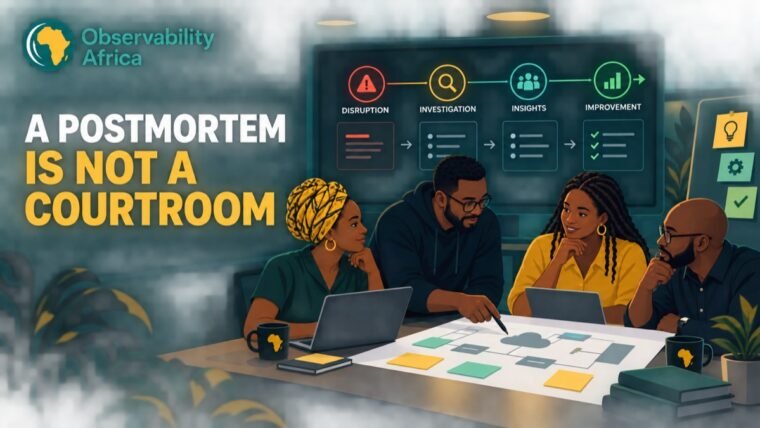
A Postmortem Is Not a Courtroom: How Lean Teams Learn Without Blame
A useful incident review explains how failure became possible. Learn how lean teams can build factual timelines, find contributing conditions, and turn lessons into verified improvements.

Alert Before the Budget Burns: Practical SLO Alerting for Lean Teams
In this guideStart with a user-centered objectiveUnderstand what burn rate meansUse two windows for urgent pagesSeparate pages from ticketsHandle low-traffic services differentlyDesign the alert […]