
Incident Readiness for Lean Engineering Teams in Africa
Why incident readiness for smaller teams should focus on clarity, critical signals, and disciplined response instead of process overload.
Many engineering teams do not fail during incidents because they lack technical talent. They struggle because incident readiness was never designed for the realities they operate in. In many African and resource-constrained environments, teams work with tight budgets, lean staffing, inconsistent connectivity, overlapping responsibilities, and high expectations from customers and leadership alike.
That means operational readiness cannot be treated as a luxury that comes after growth. It has to be built early, intentionally, and in a way that reflects the real constraints under which services are delivered.
The problem with borrowed incident models
A lot of teams inherit incident management ideas from larger organizations with round-the-clock coverage, specialized SRE teams, mature on-call rotations, and extensive tooling. Those models can be useful references, but they often break down in smaller teams where one engineer may be responsible for application support, infrastructure, customer escalation, and production fixes all in the same week.
When that happens, incident readiness becomes too dependent on individual memory. The team knows who usually solves a certain kind of issue, but not always how that issue should be diagnosed, escalated, or communicated under pressure.
What lean teams should optimize for
1. Clarity over complexity
An incident process should be easy to follow when the system is under stress and the team is tired. That means clear severity definitions, simple escalation paths, and a small set of trusted dashboards or queries that everyone understands.
It is better to have one dependable runbook for payment failures, API latency spikes, or node saturation than ten documents nobody opens during an outage.
2. Early detection of business-impacting failures
Lean teams should focus first on failures that directly affect customers, revenue, or core operations. Detection should answer questions like:
- Can users log in?
- Can customers complete transactions?
- Are critical integrations reachable?
- Is the platform responding within an acceptable threshold?
This kind of signal design matters more than filling dashboards with technical metrics that do not help the team decide what to do next.
3. Communication discipline
One of the biggest weaknesses in lean operations is not technical diagnosis, but communication drift. When nobody owns internal updates, customer messaging, or escalation tracking, valuable time disappears. Teams need a lightweight habit of documenting:
- what is happening
- who is investigating
- what changed
- what the next update time is
Even a simple incident notes template can make a measurable difference.
Minimum incident readiness checklist
If your team is still maturing, start here:
- Define 3 to 5 critical user journeys and monitor them directly.
- Create severity levels with clear business meaning.
- Maintain one runbook for your top three incident types.
- Document who gets called first, second, and third.
- Track one or two recovery metrics such as time to detect and time to restore.
- Run a simple incident review after every meaningful production issue.
Why this matters in African operating environments
In many markets, outages do not only cause inconvenience. They can directly affect trust, payment completion, energy visibility, telecom access, service adoption, and business continuity. When infrastructure is already under pressure, operational blindness becomes more expensive.
That is why incident readiness should be viewed as a business capability, not only an engineering practice. The teams that respond best are not always the ones with the biggest toolset. They are often the ones with the clearest operating model.
What to do this week
If you want a practical place to begin, take one hour this week and answer these questions with your team:
- What are the three failures that would hurt customers most?
- How would we know those failures are happening?
- Who would lead the response if they happened today?
If the answers are unclear, that is your next observability priority.
Need help improving incident readiness?
Observability Africa works with teams across telecom, fintech, energy, and digital services to improve monitoring, incident response, and operational resilience.
Explore our services or contact us to discuss your current operational readiness challenges.

About Abe Apithy
Abe Apithy is the founder of Observability Africa, a platform dedicated to helping telecom, fintech, and energy organizations design and scale resilient, high-performance digital infrastructure. His work focuses on enabling real-time system visibility, operational reliability, and performance optimization in environments where downtime, latency, and inefficiency…
Related guides

A Green Health Check Does Not Mean Users Are Fine
A healthy process can still deliver a broken user journey. Learn how to combine probes, service telemetry, and end-to-end checks.
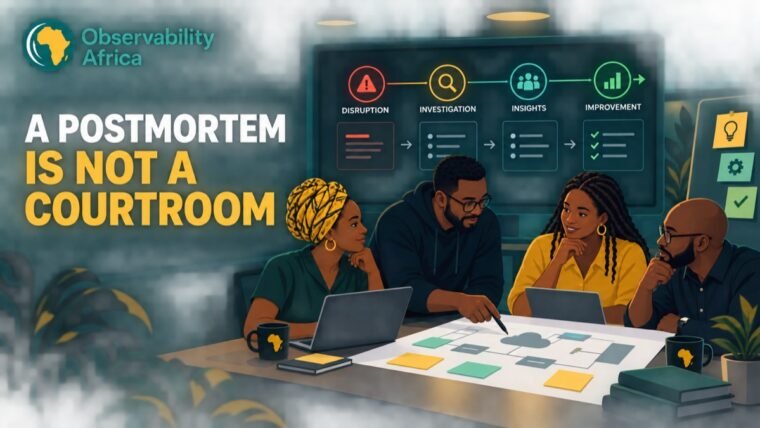
A Postmortem Is Not a Courtroom: How Lean Teams Learn Without Blame
A useful incident review explains how failure became possible. Learn how lean teams can build factual timelines, find contributing conditions, and turn lessons into verified improvements.
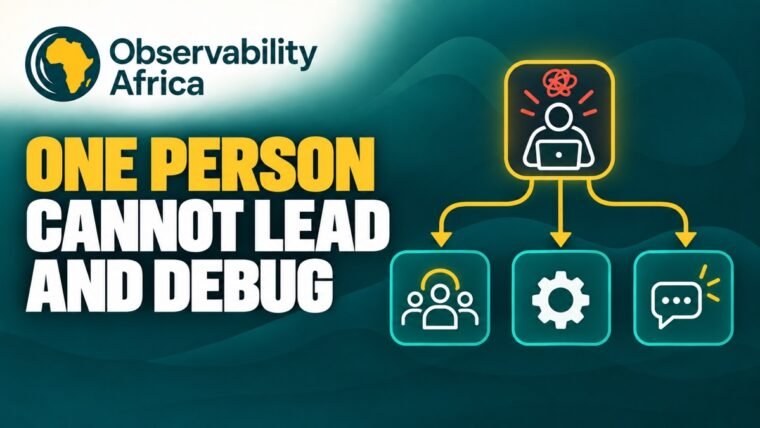
One Person Cannot Lead and Debug: A Lean Incident Command Model
Lean engineering teams need clear incident roles too. Separate command, technical response, and communication to protect focus and improve recovery.