
Can You Achieve Real Observability with Only the Essentials?
Yes, if the essentials are chosen well: service health, structured logs, meaningful alerts, and a clear path from symptoms to root cause.

Observability is often marketed as a premium capability that demands complex tooling, large data pipelines, and mature platform teams. That framing can discourage smaller organizations from starting well.
In reality, many teams can achieve strong operational visibility with a disciplined essential stack. The key is understanding which essentials actually reduce uncertainty during failure.
Where teams get stuck
Teams sometimes assume that because they cannot implement everything at once, they should delay observability investment altogether. That leaves them dependent on guesswork, user complaints, and manual database checks when incidents arrive.
What works in practice
Know service health at a glance
Every system needs a small, reliable picture of availability, latency, saturation, and error behavior for its critical paths.
Write logs for diagnosis, not for decoration
Structured logs with request IDs, dependency names, and explicit outcome fields create far more value than verbose text that cannot be searched or correlated. A consistent OpenTelemetry service naming standard keeps those dependencies understandable across traces, metrics, and logs.
Connect alerts to ownership
Even a simple alerting system becomes powerful when every alert points to the right team, the right runbook, and the right escalation path.
What to do next
- Define the smallest set of metrics that tells you whether users are succeeding.
- Standardize error logging before expanding to more advanced telemetry.
- Improve alert quality until responders trust it enough to act quickly.
Essential observability is not a compromise. For many teams, it is the most responsible and sustainable place to build from. A metric cardinality budget helps the essential signal set remain affordable as the system grows.
Need help improving observability in constrained environments?
Observability Africa works with telecom, fintech, energy, and platform teams to improve monitoring, alerting, incident response, and operational resilience.
Explore our services or contact us to discuss your current observability challenges.

About Abe Apithy
Abe Apithy is the founder of Observability Africa, a platform dedicated to helping telecom, fintech, and energy organizations design and scale resilient, high-performance digital infrastructure. His work focuses on enabling real-time system visibility, operational reliability, and performance optimization in environments where downtime, latency, and inefficiency…
Related guides

Trace the Message, Not Just the Request: Observability Across Queues
Asynchronous systems break the straight line between request and response. Learn how to preserve trace context, model message processing, and detect failures across queues.

OpenTelemetry Collector Memory Limits: Preventing Backpressure from Becoming Data Loss
A practical guide to configuring OpenTelemetry Collector memory limits, understanding backpressure, and preventing data loss during traffic bursts or backend outages.
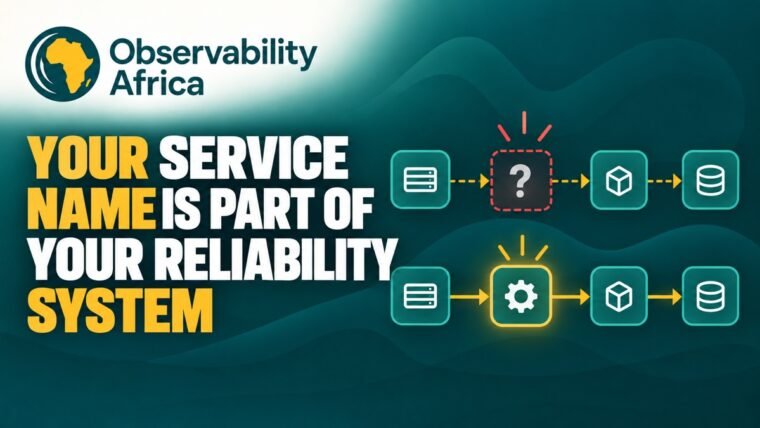
OpenTelemetry Service Naming: A Practical service.name Standard
Inconsistent OpenTelemetry service identity breaks service maps, dashboards, alert ownership, and incident response. Use a small identity contract to make telemetry dependable.